Lelantine War - c750 B.C. [5]
"The war between Chalkis and Eretria was the one in which most cities belonging to the rest of Greece were divided up into alliances with one side or the other."
"History of the Peloponnesian War" by Thucydides (Book 1. Section 15, part 3)
Both Thucydides and Herodotus [1]. [6] refer to the war between Eretria and Chalcis, both great Euboean cities[4]. Modern historians believe that with the help of their allies [1], they fought for the possession of the fertile plain watered by the Lelantos river, which flowed between the two adversaries. Geographically the plain belongs to Chalcis, it lies just east of that city. But we believe that the plain was where alot of the battles took place and that is why it is known as the Lelantine war, the main reason for the war was for dominance in the trade routes they both desperately wished for, though the Lelantine plain dominance was a good asset to have also.
According to tradition, the troops of Chalcis, aided by Thessalian cavalry, enjoyed at least one victory over the Eretrians and their allies, this may have been the decisive battle that lead to the ultimate victory. At the very same time, the site of Lefkandi was being deserted, perhaps as a consequence of the turmoil. The Lelantine plain was probably the scene of the battle between two aristocratic familys; the Hippobotes, the horse-trainers of Chalcis, and the Hippeis, the Eretrian cavalrymen [2]. The custom prohibiting the use of weapons that strike the enemy from a distance -arrows, javelins, slings; is supposed to originate in this conflict [2].
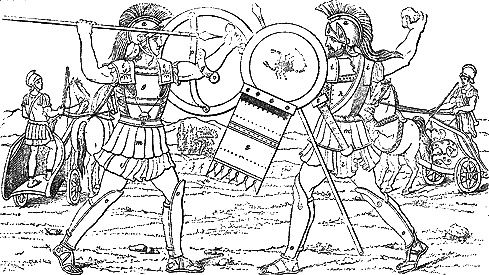
'Thrown-things' were still seen to be for cowards, to strike at a distance was not the way for grown men to fight, especially those men who grew up learning Homers epic poem 'The Iliad', the killing was done at close quarters. The battle was just when standard hoplite warfare was introduced, therefore much of the fighting was still probably single combat and not in phalanx formation.
Both cities must have been two of the most important seaports occupied by the eastern Greeks. They excelled in maritime enterprise, and Chalkis was in the earliest ages a rendezvous of Phoenician merchants. It has been suggested that the war, which was apparently fought on land by states which were strong on the sea, must have taken place before the introduction of naval fighting (Dondorff). As mentioned above the war was actually for much more than just the plains between the two. It was for the right to trade between the islands of the cyclades and the mainland. Chalkis controlled the 'Euripus Strait', which is the narrowest point between the island of Euboea and the mainland, and Eretria controlled the islands of Andros, Tenos and Ceos. This drew the interests of the Ionian cities as to help the winning side would also allow them access to through the strait and the islands. The importance of trade with the near east, and ultimately with Asia Minor had already become evident and worth fighting for. An indication to the importance of trade can be seen by the number of new colonies both founded around this time, all with access to the sea to be able to extend their trade routes.
It was also around this time that the Greek alphabet developed via Phoenicia, which may be indicative of the importance of trade developments. The long term result of the war can be seen in the allies for each side (Murray) where some traditional rivalries seem to have been established [3].
During the Ionian Revolt when Eretria and Athens joined in the liberation of the Greek cities in Ionia. Eretria joined the expedition because of the help they received from Miletus during the Lelantine War. Their help during the Ionian Revolt would latter lead the Persian king to demand their destruction during the Persian Wars.
Whereas Euboean pottery-most of it Eretrian, is found more or less throughout the Mediterranean basin, during the second half of the 8th century, by c700 B.C. it ceases to be exported. From that date onward, it appears in significant quantities only on Delos, an important religious center at the heart of the Cyclades. Attempts have been made to establish a relationship between this phenomenon and the Lelantine War.
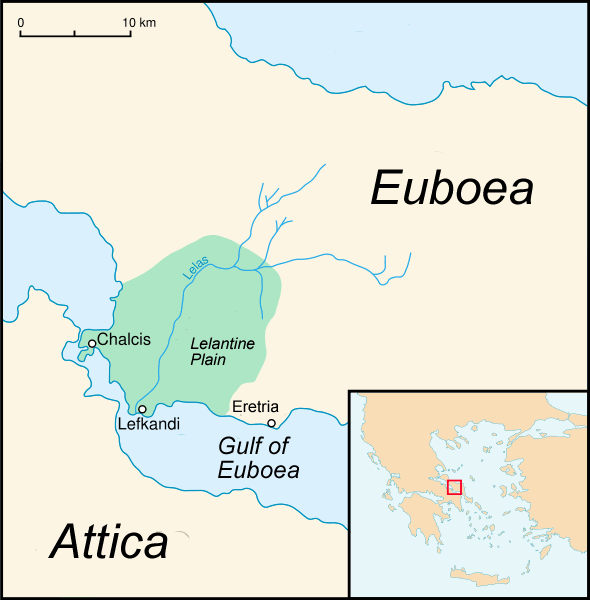
Eretria is supposed to have been defeated by Chalcis and its allies and forced to withdraw from the international scene. It has even been suggested that the polis was destroyed and temporarily abandoned at the beginning of the 7th century. But archaeological remains and the few extant literary sources suggest a very different picture. There is no doubt that Eretria continued to develop throughout the Archaic Period.
This was the first war where greater Greece took sides with either one side or the other. The numbers that fought and the actual outcome remains in doubt, but it seems the victor had rights to dominate eastern trade.
Whichever of the two cities won, however, there would have been consequences for the economy of the trading partners of the combatants. Yet we must not isolate the Lelantine War from the other outbreaks of hostilities during this period - the 1st Messenian War and the 1st Sacred War. It is worth noting that there was a treaty between the opponents in the Lelantine War, how long it lasted and its benefits is unclear.
Our sources inform us only of one battle in the war, doubtless the last, their point of departure being the death of the Thessalian Amphidamas, subject of a hymn by Hesiod. In this battle it was assistance from the Thessalian cavalry that won the day for Chalcis. On one view, the Chalcideans' victory resulted in the Spartans gaining control of the southern Peloponnese and the colonial activities of Chalcis and Corinth in the western Mediterranean being enhanced. The above led in turn to strengthening the authority of the Delphic Oracle, which exercised influence, via its oracular utterances, on the choice of where to found a new colony. The 'King of the Euboians', that is, of Chalkis, died in a Lelantine war, that is 'a' Lelantine war, for it cannot be shown that it was the great Lelantine war, as the Lelantine plain was a continual cause of friction between the two. [4]
�
Reference:
-
*1 'Histories' by Herodotus (5.99)
-
*2 'Geography' by Strabo (10.1.12)
-
*3 'Histories' by Herodotus (3.59)
-
*4 'Works and Days' by Hesiod
-
*5 'Geography' by Strabo (10.1.12)
Ancient References:
'Histories' by Herodotus 5.99.1
'The Peloponnesian War' by Thucydides 1.15.3
Strabo 10.1.11 - 12.448
'Moralia' by Plutarch 760c - 761b
D.W. Bradeen's 'The Lelantine War and Pheidon of Argos"
|
|
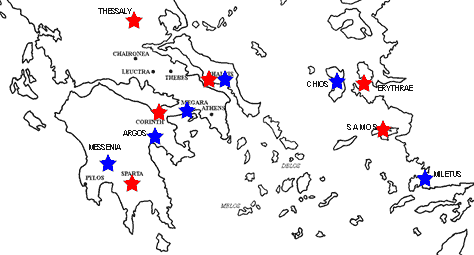
Note#1:The allies of Chalcis mentioned are Corinth, Sparta, Erythrae, Thessaly and Samos. The allies of Eretria mentioned are Megara, Chios, Messenia, Argos and Miletus.
The island of Aegina may well have been allied with Eretria [3], though not mentioned by name. Also, Strabo says that Eretria controlled the islands of Andros[7], Tenos and Ceos [5].
Note#2: There may be a connection here with the relationship on both sides to horses, and horse hair being used on helmets.
Note#3: During the Peloponnesian War Eretria was an Athenian ally against her Dorian rivals Sparta and Corinth. Also Sparta and Messenia were adversaries in this war.
Samos and Miletus adversaries here seem to have always been at odds. Over 300 years later, they would both be fighting against each other for the island of Priene, that would lead to the Battle of Samos 440 B.C.
Note#4: There is evidence to show that from the earliest times the Lelantine Plain was a plain of discord between the two cities.
NOTE#5: This war can't be dated precisely, but this struggle seems to fall between 750 B.C. and 660 B.C.
NOTE#6: There are 4 ancient references which are universally accepted as pertaining to this war. Thucydides (1.15), Herodotus (5.99.1), Plutarch and Strabo (10.1.11-12).
NOTE#7: The island of Andros which was under control of Erectria, after the war went out and founded new colonies at Stageirus, Sane and Acanthus with colonists from Chalcis. These friendly endeavors between the two are best explained as a result of Andros having been freed from Erectrian control after the Lalentine War.
History of Euboea:
Euboea was colonised in antiquity by people from Thessaly, these settlers were joined by Ionians, Aeolians and Dorians from the Peloponnese. The island, also called Makris because of its length, was divided between seven independent city-states, of which the most important were Eretria and Chalkis These two rich and powerful merchant cities founded colonies on the coasts of Thrace, Italy and Sicily, as well as in the islands of the Aegean.
|
Ancient Greek Thread
|
|
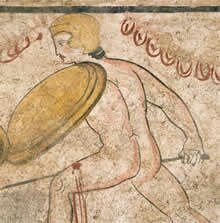
Warriors during this time*, might have generally gone to war naked. The fact that so many hoplites in ancient artwork are depicted with shield and helmet, but otherwise naked has been suggested that the Greeks thought it made the men look more heroic and virile to depict them naked instead of in armor. Though Homer does usually give a good description of the heroes' armour, in his narrative. Perhaps the nudity depicts manlyness and stems from the same concept as that caused by the Celts to go to war naked to show courage. Clothes were still a scarce luxury, not always affordable for the common hoplite. A helmet, shield and weapon, made by blacksmiths, were the most that could be hoped for, and these were handed down father to son, not supplied by the city-state.
*Image: 'Tomb Painting With a Wounded Nude Warrior From Paestum 330 B.C. The picture is for comparison purposes only and is not to be confused as an artifact from the Lelantine battles.
|
|


