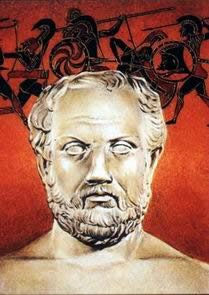
Thucydides
Courage in the face of reality ultimately distinguishes such natures as Thucydides and Plato: Plato is a coward in the face of reality-consequently he flees into the ideal; Thucydides has himself under control-consequently he retains control over things.
"Twilight of the Idols" by Nietzsch
Thucydides was an ancient Greek historian, and the author of the History of the Peloponnesian War, which recounts the 5th century BC war between Sparta and Athens. This work is widely regarded a classic, and represents the first work of its kind. Thucydides ' work is very accurate, well-spoken and researched.
He should be through of as an 'intellectual' who briefly turned his hand to playing the 'man of action'. His election as strategos, as often suggested, not so much the result of proved competence as of position and family connections.
His admoration of 'men of action' include, Brasidas (2.25.1-2, 4.11.4, 4.81.1), Pericles (1.139.4), Hermocrates (6.72.2), Phrynichus (8.27 and 68.3), Alcibiades (8.86.4-5) and even another man called Thucydides from Pharsalus is immortalised for possessing this quality (8.92.8). The reverse is true as well as his dislike of Cleon was that he masqueraded as a 'man of action' (cf.2.61.4), who couldn't even control his troops (5.7.2).
His failure at Amphipolis at the hands of the brilliant Spartan Brasidas must have been espcecially bitter for Thucyhdides to accept. Thucydides who wanted so hard to be thought of as a 'man of action' was simply outmanouvered by the Spartan, who foreigner as he was in those parts had the locals revolt from Athenian influence without a fight in the end.
Life
Almost everything we know about the life of Thucydides comes from his own History of the Peloponnesian War. Thucydides ' father was Olorus, a name connected with Thrace and Thracian royalty. He was a man of influence and wealth. He owned gold mines at Scapte Hyle, a district of Thrace on the Thracian coast opposite the island of Thasos. Thucydides, born in Alimos, was connected through family to the Athenian statesman and general Miltiades, and his son Kimon, leaders of the old aristocracy. Thucydides lived between his two homes, in Athens and in Thrace. His family connections brought him into contact with the very men who were shaping the history he wrote about.
He was probably in his twenties when the Peloponnesian War began in 431 B.C. and took part in some early action. He contracted the plague that ravaged Athens between 430 and 427 B.C., killing Pericles, in 429 B.C., along with thousands of other Athenians, but he was lucky enough to recover.
In 424 B.C. he was appointed strategos (general), and given command of a squadron of seven ships, stationed at Thasos, probably because of his connections to the area. During the winter of 424/3 B.C., the Spartan general Brasidas attacked Amphipolis, a half-day's sail west from Thasos on the Thracian coast. Eucles, the Athenian commander at Amphipolis, sent for assistance to Thucydides .
Brasidas, aware of Thucydides ' presence on Thasos and his influence with the people of Amphipolis and afraid of help arriving by sea, acted quickly to offer moderate terms to the Amphipolitans for their surrender, which they accepted. Thus, when Thucydides arrived, Amphipolis was already under Spartan control. Though he successfully held the nearby port of Eion against Brasida's attacks. In consequence he was exciled from Athens, not returning until twenty years had passed, only to die shortly after.
Using his status as an exile to travel freely among the Peloponnesian allies, he was able to view the war from the perspective of both sides. He may have travelled to Sicily for the Sicilian Expedition, as there are excellent examples of local knowledge. During this period of time he conducted important research for his history.
For much of the period he described The Peloponnesian War, it is the only source that survives. The verity of his reports and the justice of his perceptions have been the cause of controversy for centuries. He freely admits to using his imagination to reconstruct sections that he could not find, but only as a last resort. Which of these he revised and whether chronological inconsistencies are due to later editing or not, we may never know.
According to Pausanias, someone named Oenobius was able to get a law passed allowing Thucydides to return to Athens [1], presumably sometime shortly after Athens' surrender and the end of the war in 404 B.C. Pausanias goes on to say that Thucydides was murdered on his way back to Athens. Some doubt this account, seeing evidence to suggest he lived as late as 397 B.C. In any case, although he lived past the end of the war, he did not complete his history.
The abrupt end of his narrative which breaks off in the middle the year 411 B.C., suggests that he may have died while writing the book. His remains were returned to Athens and were laid in Kimon's family vault.
Legacy
Thucydides is generally regarded as one of the first true historians. Unlike his predecessor Herodotus (often called "the father of history") who included rumors and references to myths and the gods in his writing, Thucydides assiduously consulted written documents and interviewed participants in the events that he records. Certainly, he held unconcious biases for example, to modern eyes he seems to underestimate the importance of Persian intervention but Thucydides was the first historian who seems to be attempting to be completely objective. By his discovery of historic causation he created the first scientific approach to history.
A major difference between Thucydides ' history and that of a modern historians is that Thucydides ' history includes lengthy speeches which, as he himself describes, were as best as could be remembered of what was said (or, perhaps, what he thought ought to have been said). These speeches are used in a literary manner.
We are told that his work was transcribed eight times by Demosthenes, by his own hand.
In the first pages of his work he writes "I have written my work, not as an essay which is to win the applause of the moment, but as a possession for all time." He would be very satisfied indeed in knowing that more people today read his work in one year, some 2,500 years after it was first written, than all the people who read it during ancient times.
REFERENCES:
*01 Pausanias: Guide to Greece, (1.23)