Sparta and the House of Hercules
A brief history:
By about 2000 B.C. people from mainland Greece had spread into the Peloponnese, with Mycenae occupying a particularly powerful position, controlling the land route to central Greece through the Isthmus of Corinth. Homer confirms its importance, when in his poem he says that Mycenae is the stronghold of the High Kings of all the Greeks, and the site has in fact yielded the richest finds to the archaeologist; as a result, the entire early Greek culture from about 1600 B.C. has been labeled 'Mycenaean'.
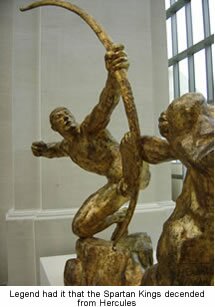
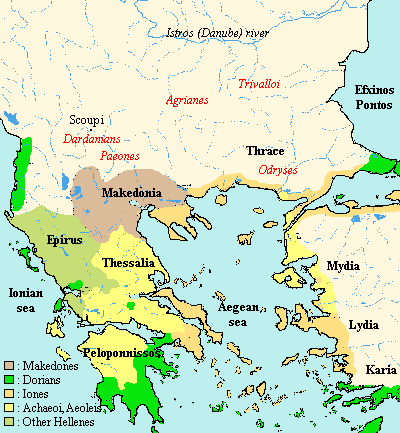 Ultimately, the Dorians (who were allowed to migrate to Greece being accepted as being people of the offspring of the son of Hercules - thus Spartans connection with Hercules) of mainland Greece invaded and are credited with orchestrating the downfall of the Mycenaean Empire, they invaded in waves at about 1100 B.C. A branch pushed south down the Eurotas valley to found their capital, thus was Sparta born. Ultimately, the Dorians (who were allowed to migrate to Greece being accepted as being people of the offspring of the son of Hercules - thus Spartans connection with Hercules) of mainland Greece invaded and are credited with orchestrating the downfall of the Mycenaean Empire, they invaded in waves at about 1100 B.C. A branch pushed south down the Eurotas valley to found their capital, thus was Sparta born.
How the Polis of Lakedaimon came to be, and how it had two basileus or in English, kings.
Originally the Dorians who came from the north settled mostly in the Vale of Sparta, near the former Mycenaean site of Therapne. These newcomers settled in two sets of villages consisting of Pitana and Mesoa, who are thought to have settled here first. Later, some other Dorians settled nearby at Limnai & Kynosoura. The first group of two villages seem to have been ruled by a clan called the Agiadai and the later two by a clan called the Eurypontidai. After an early period of internal conflicts these four villages united or synoecised into one of the earliest Polis, each of the two groups retaining their own archagetai or king. This occurred c800 B.C. After some time, Amyklai, a village some 7 kilometers south was incorporated into the 5th constituent village of the Polis of Lakedaimonia. It appears that at first there was a clan called the Aegiadai from the Amyklai area who was attempting to be recognized as a third king, but it never came about, and so Sparta remained 5 villages/komai/obai with 2 kings till almost the end of her history.
Thus after an expansion, ultimately the whole of Lakonic was taken. This brought them into conflict with the city of Argos, whose territory had included the whole of the eastern coast of the Peloponnese.
Sparta had been described as "the very worst governed people in Greece" . Both internally and in foreigner matters, to which they kept entirely aloof. A Spartan named Lycurgus (not the Athenian one) made his way to the Oracle of Delphi, as he was looking for holy approval to the plan being regarded about how Sparta should be governed.
The favorable response that the oracle gave him {O06} would put in place harsh new laws and remodel the power struggle of the region and Greece itself.
|

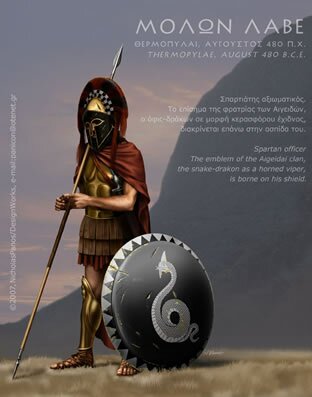
Illustration : The 'Lamda' on the Spartan's shield stands for the state that Sparta is in; not Leonidas, as some have tried to convince us. It was probably popularly used during the second half of the Peloponnesian War.
|
Sparta was in the grips of constant war with Tegea to the East, which had ravaged their countryside, and Messenia to the West, who outnumbered them many times over (15:1 per G.B. Grundy), but being predominately farmers never threatened them at home.
Lycurgus had the foresight, the divine right and being the guardian of his nephew King Labotas, the means to put in place radical new plans to make Sparta a threat to Greek supremacy against those arrogant Athenians.
See..Who was Lycurgus
It didn't take long for an expanding Sparta to come to a head with Messina to the west. After a grueling campaign( see The First Messenian war) a truce was called; but before long another war broke out (see The Second Messenian War); before ultimately Sparta turned all the Messenians into helots; whose sole purpose was to work the land so that they could feed Sparta, and they in turn could concentrate on issues of war.
|
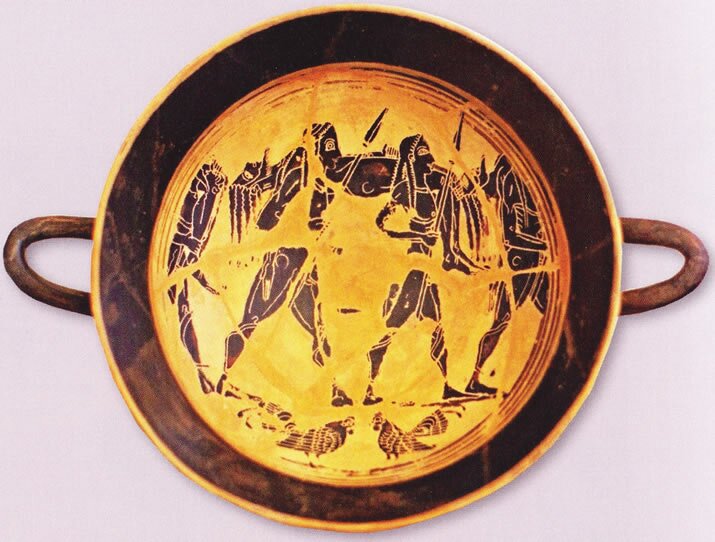
Artifact: Pottery finds from Sparta are rare, this drinking bowl is one of the few found well preserved. It shows a column of Spartans carrying their dead home. Notice how long their hair is, though not falling in front of their face. Notice the prominent eyes, the gaze look we think is a show of the 'expectations' of the city-state, what the citizens expected from their army and what the army expected from them (as an example think of your father giving you a 'stare' and you understand exactly what he means or wants). It has been dated to the mid-6 Century B.C. and now resides in the Altes Museum in Berlin Germany.
|
The City
The layout of the ancient city of Sparta is not known, and historians have placed a few congections as to its make up, using what is known of it.
Sparta was made by a synoceism of smaller villages to create a polis that would eventually be known as Sparta. Pausanias has a description of Sparta of Roman times after it had been walled and many buildings had been added, but we can use this as a guide to try to understand what Sparta might have looked like in earlier times.
Originally, four villages, Pitana, Mesoa, Limnai and Kynosoura were grouped together in order to form the original polis of Lakedaimon. Amyklai, a fifth village about 7 kilometers south of the other four was later incorporated into the polis. Sparta had an acropolis, not as high as Corinth, Argos or Athens, but upon it there was a temple to Athena called of the Bronze House because of the Bronze plaques of mythological scenes used to line the interior in the 6th C. There was a large building called the Skias, possibly of it's resemblance to a circular tent, they had an agora just south of the acropolis with offices for the Ephors and
other government officials. East of the acropolis near the Eurotas River was the compound of Artemis Orthia with a temple and altar since the 8th C. Across the river and slightly south of the main city upon the bluffs overlooking the city was the Menelaion with a pyramid shaped temple to Helen and Menelaos. Sparta was like any other Greek city, excepting Athens, with stone temples and public buildings, an acropolis and agora, her private family dwellings were most probably of dried mud-brick with red tile roofs, and more sprawled out than would have been the case in other cities. The streets would have meandered without planning, although three large avenues are known by name, one of which the Hyakinthine Way led south from the main part of Sparta town south towards Amyklai, and along which lay the syssitia, or public messes, each of which would have had facilities for its unmarried members to sleep, the so-called dormitories or barracks.
The Government
The government in Sparta was like no other in ancient Greece, it had two kings, 28 council members who with the 2 kings were responsible for interpretations of the law. And 5 ephors who's main responsibility was to judge the rule of the 2 kings. The Spartan assembly consisted simply of all Spartinites who were adult male, full-blooded Spartans.
The Government - Gerousia
Lykourgos chose the original twenty-eight elders of the Gerousia including the 2 kings made up the 'Council of Elders'. Each subsequent elder of the Gerousia had to be aged over 60 and was "elected" for life. The choice of possible elders, however, remained quite limited. Only men coming from a select few noble families qualified. The Gerousia was primarily a lawcourt for "important cases," but it could also reject "crooked decisions" of the assembly. The assembly had the authority to make proposals in the Gerousia and to decide matters brought before it. The major decisions it could render, however, remained scant and few (the Spartans also appear to have had a "small assembly" that could meet for crises). On the other hand, it (not the Kings) decided war or peace (perhaps the most important decision of all), and it could appoint field commanders if an army was called-up by the Ephors.
The Government - Kings
The Kings of Sparta ran hereditary and were limited to being commanders of the army and religious "heads of state" (lit. priests of Zeus). They could, however, assemble and march an army on their own authority. Each line of kings had their own hereditary line these were the Agiads and the Eurypontids.
The Government - Ephors
The Ephors appear to have been chosen by lot, not elected by vote. The Ephors convened the Gerousia and could call an assembly. They also possessed judicial powers: they could bring a King to trial and had considerable authority to direct punishments. They also oversaw the agoge, the schooling of Spartan from the age of 7.
The Kings of Sparta
|
Herakles

Hyllos
Kleodaios
Aristomachos
|
|
|
|
Eurysthenes
1st, ? -930bc
|
|
Prokles
1st, ?-930bc
|
|
Agiads |
|
Agis I
2nd, 930bc-900bc
Echostratos
3rd, 900bc-870bc
Labotas
4th,870bc-840bc
Doryssos
5th, 840bc-820bc
Agesilaos I
6th, 820bc-790bc
Archelaos
7th, 790bc-760bc
Teleklos
8th, 760bc-740bc
Alkamenes
9th, 740bc-700bc
Polydoros
10th, 700bc-665bc
|
|
Soos,
2nd, ?-890bc
Euryphon
3rd, 890bc-860bc
Prytanis
4th, 860bc-830bc
Polydektes
5th, 830bc-800bc
Eunomos
6th, 800bc-780bc
Charillos
7th, 780bc-750bc
Nikandros
8th, 750bc-720bc
Theopompos
9th, 720bc-675bc
Anaxandridas I
10th, 675bc-645bc
Archidamos
|
|
Eurypontids |
|
|
|
|
|
Eurykrates
11th, 665bc-640bc
Anaxandros
12th, 640bc-615bc
Eurykratides
13th, 615bc-590bc
Leo or Lindius
14th, 590bc-560bc |
|
Zeuxidamos
11th, 645bc-625bc
Anaxidamos
12th,625bc-600bc
Archidamos
13th, 600bc-575bc
Agasikles
14th, 575bc-550bc |
|
Anaxilas
Leotychides
Hippocratides
Agesilaos |
|
Anaxandridas II
15th, 560bc-520bc |
|
Ariston
15th, 550bc-515bc
|
|
Menares |
|
|
|
|
|
|
Kleomenes I
16th, 520bc-489bc
|
|
Dorieus |
|
Leonidas I
17th, 490bc - 480bc
Killed in the Battle of Thermopylae
|
|
Kleombrotos |
|
Demaratos
16th, 515bc-491bc (deposed)
|
|
Leotichydas
17th, 491bc-469bc
|
|
|
|
|
|
|
|
|
Pleistarchos
18th, 480bc-458bc
|
|
Pausanias
Regent for Pleistrachos
|
|
|
Zeuxidamos |
|
|
|
|
|
|
Pleistoanax
19th, 458bc-444bc
|
|
|
Archidamos II
18th, 469bc-427bc
|
|
|
|
|
|
Pausanias
20th, 444bc-394bc
|
|
Agis II
19th, 427bc-398bc
|
|
Agesilaos II
20th, 398bc-361bc
|
|
|
|
|
|
|
Agesipolis I
21st, 394bc-380bc
|
|
Kleombrotos I
22nd, 380bc-371bc
|
|
|
|
Archidamos III
21st,361bc-338bc
|
|
|
|
|
|
|
Agesipolis II
23rd, 371bc-369bc
|
|
Kleomenes II
24th, 369bc-309bc
|
|
|
Agis III
22nd, 338bc-331bc
|
|
Eudamidas I
23rd, 331bc-300bc |
|
|
|
|
|
|
Akrotatos |
|
Kleonymos |
|
|
|
Archidamos IV
24th, 300bc-275bc |
Areus I
25th 309bc-264bc
|
|
Leonidas II
28th, 254bc-235bc
|
|
|
|
Eudamidas II
25th 275bc-245bc |
|
|
|
|
|
Akrotatos
26th, 264bc-262bc
|
|
Kleomenes III
29th, 235bc-221bc
|
|
Eukleidas
29th, Eurypontid King 227bc-221bc
|
|
Chilonis
m. Kleombrotos II (242-1) |
|
Agis IV
26th 245bc-241bc
|
|
Archidamos V
28th, 228bc-227bc |
Areus II
27th, 262bc-254bc
|
|
|
Eudamidas III
27th 241bc-228bc |
.
How the Sparta got it's name, through legend.
Tradition has it, that the Heraclidae brothers, descendants of the hero Herkules, Kresphontes, Temenos and Aristodemos came to conquer the Peloponnese. Aristodemos was hit by lighting and died at Naupactos, leaving behind his twin sons Eyresthenes and Prokles. His brothers crossed the gulf and landed at Achaia.
There was a battle with the forces of the monarch of Peloponnese, Tisamenes, and they were victorious. When the Dorian phalanx came in the territory of Lakonia and Messene, it was guided by Kresphontes, who inhabited the rich plain of Pamesos. There was a constant quarrel between the Dorian chiefs, Kresphontes and Theras, to share the territory.
Theras, the brother of Aristodemos wife, who was guardian to her twin children after the death of her husband, wanted to take the rich Messene, but Kresphontes and his brother Temenos, who was ruling Argos, played a trick on him.
They arranged to throw in the water two small tiles, with the names of Kresphontes and Theras written on them and the one which would surface in the water, would win Messene, the other the less rich Laconia.
Kresphontes tile was baked in the fire, while Theras was left in the sun and when both were thrown into the water, Theras tile went to the bottom and Kresphontes tile floated and thus he took Messene.
|
Photius records in his Lexicon of the 9th C. AD (s.v. Lambda) the remark of Eupolis (fl. last quarter 5th C. BC) that "'The Lakedaimonians painted a lambda onto their shields while the Messenians painted an M", though as the confusion at the battle of Delion described by Thucydides (iv.96) suggests standardised shield devices were uncommon in the 5th C. BC.
|
Spartan Red Cloaks:
Spartans were famous for wearing red cloaks. But we do not have any certainty how they dyed their cloaks red. A plant from the 'Madder' family found in the area seems to be able to do this. Go to Madder Family (Rubiaceae), to read more.
|
|
Spartans Black Broth
by Sander van Dorst (TP 329-330)
There is a description of a black soup eaten in Sparta that would make a person from another city-state puke. This and its variations found in ancent sources in: M: Lavrencic, Die Spartanische Kueche (Taschenbuch
(1993) Böhlau, Köln) ISBN: 3205980123.
The main ingredients for the Spartan haimatia (also bafa or melas zoomos) is pig's blood, boiled pork, vinegar and salt. There are no clear clues to quantities or precise manner of preparing the blood broth. Please remember the anecdote that a king who had tasted this dish remarked that he finally understood why the Spartans did not fear death before attempting to cook this for a dinner party. Courses that were related to this Spartan dish and current in other parts of the Greek world included the extra ingredients of honey, cheese, kummel (I could not find the English word for that my dictionary) in addition to the vinegar and salt. As sidedishes one can serve maza (barley bread), figs, cheese, olives as the common sidedishes that formed part of the aiklon and more luxurious Greek dishes (including wheaten bread, game meat and poultry) as epaiklia, the voluntarily contributed extra courses. A cake made of barley meal, honey and olive oil served on laurel leaves would be a fitting desert for a Spartan meal. Watered down wine was the main drink, this being drunk from the individual cups rather than from the common vessel used in other Greek cities.
|
To read more about Spartan religion goto here.
|