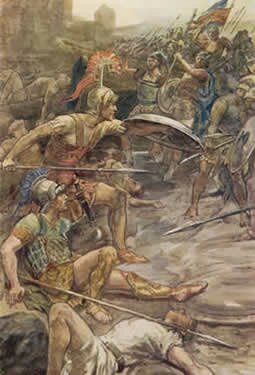
Epaminondas
Who is Epaminondas?
Epaminondas was a Boeotarch (General) of the city of ancient Thebes and at his height was one of the greatest military tacticians in ancient greek history, he will be forever remembered for being the man responsible for permanently breaking the grip of Spartan haemogeny over the Greek city-states, with his spectacular unexpected victory at the Battle of Leutra 371 B.C. A great military inovator, he helped install the Theban army to new military tactics that would make the old phalanx style of fighting redundant.
Early life
Little is known about his early life, he was the son of a Theban aristocrat, though they were relatively poor, he did receive a good education. Particularly attracted to philosophy, he became a devoted pupil of Lysis of Tarentum , a Pythagorean, who had settled in Thebes . Epaminondas did not at first take any part in political life but served on military expeditions as a hoplite warrior.
He lived his entire life in near-poverty, refusing to enrich himself by taking advantage of his political power. Cornelius Nepos notes his incorruptibility, describing his rejection of a Persian ambassador who came to him with a bribe. In the tradition of the Pythagoreans, he gave freely to his friends and encouraged them to do likewise with each other. These aspects of his character contributed greatly to his renown after his death.
Pelopidas
His close and enduring friendship with Pelopidas, unbroken over a long series of years, amidst all of their military and civil offices which they held together, strikingly illustrates the sympathy and similarity between the two. Their friendship originated in the campaign in which they served together on the same side as Sparta, against Mantineia, where Pelopidas having fallen in a battle, apparently dead, Epaminondas protected his body at the imminent risk of his own life, 385 B.C.
Humble military beginnings
In the year 382 B.C. Spartan forces successfully took advantage of an expedition to northern Greece to conspire with a few Thebans for a sudden coup at Thebes. For three and a half years the government was in the hands of this small dictatorship, backed by a Spartan garrison in the Cadmeia (the citadel of Thebes). Many of the Theban leaders, including Pelopidas, were driven into exile. Epaminondas remained at Thebes in no political capacity, but when Pelopidas returned secretly from Athens, he successfully overthrew the dictatorship in 379 B.C. and frightened the Spartan garrison into surrender, Epaminondas is said to have been one of those who led the popular uprising in Thebes. No individual part is attributed to him for the next eight years, during which Thebes, in alliance with Athens, successfully fought off Sparta and re-established its traditional leadership in a federation of the cities of Boeotia. In 371 B.C. the general war was ended at a peace conference, but Sparta and Athens combined to refuse recognition of the Theban federation by insisting that each city of Boeotia should be a separate party to the treaty, while Thebes claimed that its federation should be treated as a single unit. Epaminondas, who was boeotarch (one of the five magistrates of the federation), maintained this position, even when it led to the exclusion of Thebes from the peace treaty. The Spartans had an army stationed on Thebes's western frontier, waiting to follow up their diplomatic efforts by a crushing military attack [4] [5].
The Battle of Leuctra 371 BC
At the Battle of Leuctra 371 B.C. Epaminondas was ready with relatively new tactical innovations, he lead the Theban army and their allies to crush the Spartan forces. This monuntental defeat to Sparta cause ripples through the rest of Greece. The great Spartan military machine that had known so many victories, indeed victories that included their opponents on the battle field to simply flee once they realised that the Spartans were their opposition, and who had known a great string of victories, were humbled by the Thebans. The defeat of the Spartans inflicted such heavy losses, that it seriously threatened the possibility Sparta not being able to raise another army. The Boeotian federation had been saved, and after more than a year the Theban army, once more led by Epaminondas, proceeded to press home its victory.
The First Peloponnesian Invasion
In the winter (a most unusual season for Greek warfare) of 370–369 B.C. the Thebans lead by Epaminondas invaded the Peloponnese and penetrated the valley of the Eurotas (modern Evrótas). For the first time for at least two centuries an enemy army was in sight of Sparta. The subject population of Helots revolted, and Epaminondas re-created the state of Messenia, which had been enslaved by the Spartans for 300 years. He also encouraged the Arcadians , who had broken from Sparta's league, to found Megalopolis (Big City) as a federal capital. These new political creations served to keep Sparta in check so that it was never again a serious military power outside the Peloponnese [6].
Trouble at Thebes
Epaminondas' brilliant success was met with jealousy and political opposition at home. At home he was impeached by enemies on a capital charge of having retained command beyond the legal term. The fact itself was true enough, but he was honourably acquitted, Epaminondas having expressed his willingness to die if the Thebans would record that he had been put to death because he had humbled "Sparta and taught his countrymen to face and to conquer her armies". Against his accusers he was philosophical and magnanimous enough, unlike Pelopidas, to take no measures of retaliation [7].
The Second Peloponnesian Invasion
In the spring of 368 B.C. he again led a Theban army into the Peloponnese, and having been vainly opposed at the Isthmus by the forces of Sparta and her allies, including Athens, he advanced against Sicyon and Pellene, and obliged them to give up their alliance with the Lacedaemonians; but on his return, he was repulsed by Chabrias in an attack which he made on Corinth. It seems doubtful whether his early departure home was owing to the rising jealousy of the Arcadians towards Thebes, or to the arrival of a force, chiefly of Celts and Iberians, sent by Dionysius I, to the aid of the Spartans [8].
The Thessalian Invasion
Later on in 368 B.C., we find him serving, but not as general, in the Theban army which was sent into Thessaly to rescue Pelopidas from Alexander of Pherae, and which Diodorus tells us was saved from utter destruction only by the ability of Epaminondas. According to the same author, he held no command in the expedition, because the Thebans thought he had not pursued as vigorously as he might his advantage over the Spartans at the Isthmus in the last campaign. The disaster in Thessaly, however, proved to Thebes his value, and in the next year (367) he was sent at the head of another force to release Pelopidas, and accomplished his object, according to Plutarch, without even striking a blow, and by the mere prestige of his name [9].
It would appear—and if so, it is a testimony to his virtue—that the Thebans took advantage of his absence on this expedition to destroy their old rival Orchomenus,—a design which they had formed immediately after their victory at Leuctra, and which had been then prevented only by his remonstrances [10].
The Third Peloponnesian Invasion
In 366 B.C. he invaded the Peloponnese for a third time, with a view to strengthening the Theban position there. He obtained assurances from several states and, perhaps because of these assurances, decided not to overthrow the oligarchical governments that had been established by the Spartans. This was not accepted by the Theban government, which was in favour of overthrowing the oligarchs and establishing new democracies [11].
In 363 B.C., when the oligarchical party in Arcadia had succeeded in bringing about a treaty of peace with Elis, the Theban officer in command at Tegea at first joined in the ratification of it; but afterwards, at the instigation of the chiefs of the democratic party, he ordered the gates of Tegea to be closed, and arrested many of the higher class. The Mantineians protested strongly against this act of violence, and prepared to resent it, and the Theban then released the prisoners, and apologised for his conduct. The Mantineians, however, sent to Thebes to demand that he should be capitally punished; but Epaminondas defended his conduct, saying, that he had acted more properly in arresting the prisoners than in releasing them, and expressed a determination of entering the Peloponnesus to carry on the war in conjunction with those Arcadians who still sided with Thebes [12].
Athens at his stage supported Sparta, and was at war with Thebes. In 364–363 Epaminondas made a bold attempt to challenge Athens' naval empire. With a new Boeotian fleet, he sailed to Byzantium, with the result that a number of cities in the Athenian Empire rebelled against their now-threatened masters.
The Fourth Peloponnesian Invasion
But the next year the outbreak of civil war in the Arcadian league brought Epaminondas once more to the head of a large allied army in the Peloponnese. Against a formidable coalition of states, including Athens and Sparta, that Epaminondas invaded the Peloponnesus, for the fourth time. The difficulties of his situation were great, but his energy and genius were fully equal to the crisis, and perhaps at no period of his life were they so remarkably displayed as at its glorious close. Advancing to Tegea, he took up his quarters there; but the time for which he held his command was drawing to an end, and it was necessary for the credit and interest of Thebes that the expedition should not be ineffectual. When then he ascertained that Agesilaus was on his march against him, he set out from Tegea in the evening, and marched straight on Sparta, hoping to find it undefended; but Agesilaus received intelligence of his design, and hastened back before his arrival, and the attempt of the Thebans on the city was baffled. They returned accordingly to Tegea, and thence marched on to Mantineia, whither their cavalry had preceded them.
The Battle of Mantineia 362 BC
Thus the stage was set for the Battle of Mantineia (362 B.C.), and in which the peculiar tactics of Epaminondas were brilliantly and successfully displayed, he himself, in the full career of victory, received a mortal wound, and was borne away from the throng. He was told that his death would follow directly on the javelin being extracted from the wound; but he would not allow this to be done till he had been assured that his shield was safe, and that the victory was with his countrymen. It was a disputed point by whose hand he fell: among others, the honour was assigned to Gryllus, the son of Xenophon. He was buried where he died, and his tomb was surmounted by a column, on which a shield was suspended, emblazoned with the device of a dragon—symbolical (says Pausanias) of his descent from the blood of the Σπαρτοι, the children of the dragon's teeth [13].
Conclusion
Ancient Greece supplied little or no scope for any but the narrowest patriotism, and this is perhaps never more apparent than when we think of it in connexion with the noble mind of one like Epaininondas. We do indeed find him rising above it, as, for instance, in his preservation of Orchomenus; but this was in spite of the system under which he lived, and which, while it checked throughout the full expansion of his character, sometimes (as in his vindication of the outrage at Tegea) seduced him into positive injustice. At his best, he had the mind of a military genius, and today we can look back and appreciate his many splendid qualities. [14].
Additional Reading
Of ancient sources, Nepos' Epaminondas is vague and moralizing. Plutarch's Life of Epaminondas is lost but can be indirectly approached through his Life of Pelopidas and Pausanias. There is no important single work on the subject by a modern scholar, so it is best studied in the standard general histories like M. Cary in the Cambridge Ancient History, vol. 6, ch. 4 (1927); and N.G.L. Hammond, A History of Greece to 322 BC, 2nd ed., ch. 2–3 and appendix 7 (1967), in which special attention is given to the chronological problems.
~~~~~~~~~`
References:
Footnotes:
-
*01 :(Plut. Pelop. 3, de Gen. Soc. 8, &c.; Ael. V. H* ii. 43, iii. 17, v. 5, xii. 43 ; Paus. iv. 31, viii. 52, ix. 13; C. Nep. Epam. 1, 2; comp. Fabric. Bill. Graec. vol. i. p. 851, and the works of Dodwell and Bentley there referred to.)
-
*02 (Plut. Pelop. 4; Xen. Hell. v. 2. § 1, &c.; Diod. xv. 5, 12 ; Paus. viii. 8.)
-
*03 (Plut. Pelop. 5, 12, de Gen. Soc. 3; Polyaen. ii. 2 ; Xen. Hell. v. 4. § 2, &c.)
-
*04 (Xen. Hell. vi. 3. §§ 18—20, 4. §§ 1—15 ; Diod. xv. 38,51—56; Plut. ^5.27,28, Pelop. 20—23, Cam. 19, Reg. et Imp. ApopJi. p. 58, ed. Tauchn., De seips. cit. inv. laud. 16, De San. Tuend. Praec. 23 ; Paus. viii. 27, ix. 13 ; Polyaen. ii. 2 ; C. Nep. Epam. 6 ; Cic. Tusc. Disp. i. 46, de Off. i. 24; Suid. s. v. ^EiraiMvoovdas.)
-
*05 (Xen. Hell. vi. 5. § 6, &c.; Paus. viii. 27, ix. 14 ; Diod. xv. 59 ; Aristot. Polit. ii. 2, ed. Bekk.)
-
*06 (Xen. Hell. vi. 5. § 22, $c., 33—52, vii. 1. § 27; Arist Polit. ii. 9, ed.Bekk. ; Plut. Pel.<24> Ages. 31— 34; Diod. xv. 62—67 ; Paus. iv. 26, 27, ix. 14 ; Polyb. iv. 33 ; C. Nep. IpTi. 21.)
-
*07 (Plut. Pelop. 25, De seips. cit. inv. laud. 4, Reg. et Imp. Apoph. p. 60, ed. Tauchn. ; Paus. ix. 14 ; Ael. F. H. xiii. 42 ; C. Nep. Epam. 7, 8.) [pelopidas ; menecleidas.]
-
*08 (Xen. Hell. vii. 1. §§ 15—22 ; Diod. xv. 68—70; Paus. ix. 15.)
-
*09 (Diod. xv. 71, 72, 75 ; Plut. Pelop. 28, 29.)
-
*10 (Diod. xv. 57, 79 ; Paus ix. 15 ; Thirl-wall's Greece, vol. v. pp. 120,121.)
-
*11 (Xen. Hell, vii, 1.§§ 41—43; Diod. xv. 7£.)
-
*12 (Xen. Hell. vii. 4. §§12—40.)
-
*13 (Xen. Hell. vii. 5 ; Isocr. Ep. ad Arch. § 5 ; Diod. xv. 82—87; Pint. Ages. 34, 35, Apoph. 24; Paus. viii. 11, ix. 15; Just. vi. 7, 8; Cic. ad Fam. v. 12, de Fin. ii, 30;: Suid. s. v. 'Επαμινωνδασ; C. Nep. Epam. 9 ; Po-, lyb. iv. 33.)
-
*14 (Ael. V. H. vii. 14; Cic. de Orat. iii. 34, de Fin. ii. 19, Brut. 13, Tusc. Disp. i. 2 ; Polyb. vi. 43, ix. 8, xxxii. 8, Fragm. Hist. 15; C. Nep. Epam. 10; Aesch. de Fals. Leg. p. 42.) [E.E.]
-
-
- Artwork
- Isaak Walraven: 1686-1765: The death bed of Epaminondas. Rijksmuseum, Amsterdam.
-
Death of Epaminondas , David d'Angers