Battle of Hysiae - 669 B.C. (aka Hysiai)
Here are common graves of the Argives who conquered the Lacedaemonians in battle at Hysiae. This fight took place, I discovered, when Peisistratus was archon at Athens , in the fourth year of the twenty-seventh Olympiad , in which the Athenian, Eurybotus, won the foot-race. On coming down to a lower level you reach the ruins of Hysiae, which once was a city in Argolis, and here it is that they say the Lacedaemonians suffered their reverse.
Pausanias' Description of Greece (Book 2 Section 24 Part 7)
The city in Greek is written as Ὑσιαί, is sounds like 'Ee-sea-Ae'
Sparta's continual attempts to make sure surrounding cities did not have enough strength to challenge their dominance, put them in loggerheads with Argos.
The reunification of the tribe of Temenus by Pheidon gave the city-state a great influence in the Peloponnese.[1]
The Spartans marched out of Sparta with the intention to decimate Argos and make them surcome to the will of Sparta. Instead of coming out to meet them in the fields on the outskirts of the city. King Pheidon of Argos drew his forces up in a sort of prototype phalanx formation in Hysiae a city south-west of Argos that lay between Argos and Sparta, the city was still under Argo's influence.
In the past, King Pheidon of Argos had organised a small type of body-guard force to protect him in Argos, this crack force was used to keep citizens at bay as previous rulers had more often than not been assasinated by the Argos aristocracy. One of the evolution of the body-guards were to be given the larger aspis as a shield, to help shield the king. The benefits of the larger aspis was quickly established.
Usually, two armies would have met in the open fields to do battle leaving more than enough room for maneuverability. It is thought Argos chose the town of Hysiae to tightly pack in their forces (scholars are not sure how this was done), forcing the Spartans to meet them head on.
It is argued that previous to this battle soliders would use a medium shield (sometimes called a buckle) that had a grip in the middle that allowed it to be held onto by the left hand. It was used to deflect the opponents blow and allow time for the solider to have an attempt to strike. But at Argo they made the aspis larger and tougher, as the ones the kings body-guard were using. The wearer could now hook his forearm into the aspis and a grip was placed near the edge of it ( see how the hoplite's arm is used to carry the aspis in the picture to the far right ). This allowed for much more flexibility and more scope for protection, but much more importantly it allowed much more power or force to be used against an opponent as the aspis could now more easily 'push off' an opponet or unbalance them, allowing for more chance of success with the next strike. In ancient times this shield would become to be called the Argive (as in the design belongs to the city of Argos)
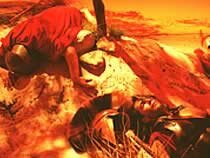
Artwork
|
The development of the aspis lead to the development of the phalanx. Now large number of men could line up side by side providing fantasic cover to be able to strike out at an opponent.
The Spartans who had not as yet mastered the phalanx style of fighting were overcome and routed by the hoplites of Argos, in this relativley new style of fighting.
The defeat put a stop to all Spartan military expanstion and placed Argos as a leading power in Greece, at least for the time being.
The Greek historian Pausanias claimed he saw the common monument to the Argives for this victory in this battle against the Spartans, while he was touring around Greece, around 150 A.D. [1]. ,about 810 years later.
While the Argive victory over the Spartans in 669 B.C. is almost universally accepted as historical fact, from time to time scepticism has been voiced. Here we will not delve too much about the doubts but it's worthwhile listing the grievences and observations.
* It has been argued that the resulting Spartan defeat at Hysiae provided the Messenians with an opportunity to revolt against them and lead on to the Second Messenians revolt.
*That the Gymnopaediae was institued at Sparta in the following year to commemorate the bitter defeat at Hysiae. [2].
*Only one ancient author, Pausanias, mentions the Battle of Hysiae, and he lived and wrote approximately eight hundred years after the battle was supposedly fought. [3].
*Other events in Pausanians' book can be dated by the areas current king or leaders. In contrast this Peloponnesian battle is dated by giving the name of a Athenian archon and the Olympic victor. As the information given to Pausanians occured at Argos, why didn't the current Argo king want to have his name attached to the victory? Maybe it is because it was not a Argive victory, but a Spartan one.
It is through Pausanians naming of the Olympic victor that the date of the battle can be identified as 669 B.C. [4].
*The city of Tegea was perilously close to the battle, what role if anything did they have?
NEXT PAGE>>>The Battle of Senyclarus
References:
-
*1 'Description of Greece' by Pausanias (Book 2. 24.8)
-
*2 'A Note on the Origin of the Spartan Gymnopaidai' (1949) by H.T. Wade-Grey pp 79-81
-
*3 'Description of Greece' by Pausanias (Book 2. 24.7)
-
*4 Pausanias names Eurybotus as the winner of the footrace at Olympia, this has been cross referenced with the year 669 B.C. where Eurybates, a dialectical variation, was named by a later author Dionysius of Halicarnassus




