10,000 Athenians marched out of their city to met the Persians, 80,000 strong [1] who had landed at Marathon [2], the Persians had with them the ex-tyrant of Athens, Hippias, to try to be able to gain sympathisers in the Athenian camp. The Athenians promptly stood on the defense, to combat the superior cavalry that the Persian had, they felled a number of trees and set them in position on the plain. Their army had ten generals, one of them was Miltiades who was in command. While in preparation of the oncoming battle every available man from Plataea arrived, 600 in all to aid Athens. In honour of a previous battle where Athens came to the defense of Plataea against the Thebans.
The generals were not all inclined on what to do, some said not to risk a battle against so many an enemy but others said the time to fight is now, with Miltiades leading the chorus for a fight now. Fearing that things were not going his way, Miltiades said, that the war-archon had also a right to vote, and they all agreed that he should have the final say. Miltiades spoke with the war-archon, Kallimachus, and gained his vote; for battle.[3]
Each day, a different general was to lead the army, and while on each general's turn they gave up their right of command over to Miltiades, he did not usher them into battle, though he did accept their offers. Aristeides was also a general. Between the 7th and 11th of August, nothing happened.
Both sides sat on the defense neither wanting to advance on the other, each having excellent reason not to attack first. The Athenians, who possessed neither archers nor cavalry, were unwilling to operate in the open plain, where Datis's cavalry squadrons would have them at a severe disadvantage. They still hoped too that if they could delay long enough, help was promised from Sparta. After four days the moon would be full, and a Spartan army - with any luck - would be on its way to join them. The longer the Athenians sat tight, the better their chances. The Persian's too had their own motives for not wishing to force an immediate engagement. If the Athenians were shy of encountering Persian cavalry, Datis and Artaphernes, conversely, had no wish to launch their own weaker infantry against Greek hoplites holding a prepared position. More importantly, they were in touch through Hippias with a group at Athens who had promised to betray the city to the Persian invaders. Those slippery opportunists the Alcmaeonidae were, almost certainly, among the ringleaders[4]. When everything was ready, the conspirators would flash a shield on Mt Pentele. There is no hard evidence to indicate what the signals were to mean. There have been reconstructions and the following are from those.
If the signal from the shield meant that the gates of Athens were ready to be opened, then the response would have been an advance on the city itself, and bypass a land fight. The Persians would have sent the bulk of their fleet to Phaleron Bay and a large part of the cavalry would accompany the assault group and act as a spearhead. Best of all Athens entire citizen army would be immobilised at Marathon by Artaphernes' holding force. If Athens army tried to withdraw, they would have of course been attacked at once, at a severe disadvantage. As soon as Athens fell, Datis' troops would march out along the same coast road as the Athenian army had taken. Kallimachus would have to be compelled to fight a simultaneous frontal and rearguard action, between the mountains and the sea, against vastly superior numbers. Until this trap was to be sprung, the Persian force at Marathon need do nothing - unless the Athenians either attacked or attempted to withdraw.
The Persians lead by Datis and Artaphernes must have known all about those Spartan reinforcements, and the alleged reason for their delay. After such a long time waiting, further waiting might prove highly dangerous. Yet there was still no signal from the pro-Perisan party in Athens. A crucial decision now faced the Persian commanders; and it looks like they made up their minds to take a chance, and go ahead with their planned operation regardless.
Under cover of darkness they decided to put the bulk of their cavalry on their ships, a detachment would be needed for Artaphernes' holding force at Marathon. The bulk of the army too would have been set aboard. It seems likely that there was still a substantial body being left behind at Marathon. Even though with the coming of daylight and the landing at Athens becoming common knowledge, they did not expect their opponents to risk an attack without archers or cavalry.
The Persians were hoping for the benefit of treachery to favour them, but it was the Athenians who actually got the benefit. Some Ionian scouts serving with Artaphernes noticed the absence of Datis' cavalry and slipped across the battle lines before dawn, carving a message on a olive tree, bearing the message that would later on, be famous - 'the cavalry are away'.
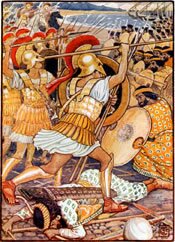 When Miltiades' turn came to be commander of the army and being the eleventh day after the Persian landing, the Athenian battle was set in array. (Obviously, Miltiades was leader on day one and eleven).
Lining up in battle formation at a distance of 8 furlongs (about a mile) from the invaders, Miltiades had already discussed how the battle should take place.
Three very distinct tactics were going to be used in the upcoming battle.
Firstly, it had always been usual for an army to march in unison and in cohesion as they advanced forward, usually to the sound of pipes. This was because being in phalanx formation a tightly packed force would leave little gaps for the enemy to be able to exploit. This would be very disadvantageous here, the Persian archers would be deadly, there were thousands of them hailing down a shower of arrows, the slower the Athenians marched the more times an archer could shoot. The Athenians would attack at a run, giving less chance of the archers to get off their shots.
Secondly, the Athenians were hopelessly outnumbered, they were about 11,000 hoplites only, against a force of Persians who must have been more than twice as strong (historians say anything up to 80,000) because they thought the Athenians 'were so few' [1] . A phalanx army at that time usually was 8 man deep but this would not work here as the Persian line would easily outwing them. The Athenian line was realigned to allow the front line to line up the same size as the Persians, this did not allow the standard 8 man depth for the phalanx. To compound the problem the wings of the Athenian line was reinforced, leaving a token force to handle the middle ( 2 maybe 3 deep).
Thirdly, it was a habit of that time (and it would continue well past 1000 A.D.) that when braking through enemy lines, soldiers would pursued on, killing the retreating as they went until reaching the baggage camp and either continued after the retreating soldiersor plundered the baggage for spoils. This would not be allowed here, if either of the heavily soldiered wings broke through they were not to charge down fleeing Persians, but must stay in the foray and continue to help where they could. (A revelation to be sure see how this effected the outcome of the Battle of Mantinea 418 B.C. )
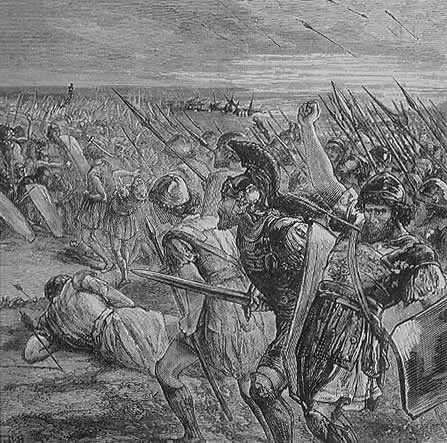 In early morning, the call came and the Greeks marched at the barbarians, when they reached between 150 to 200 yards they were commanded to attack at a run[8]. There was no shouting, no battle-song: they needed all the breath they had. The Persians, therefore, when they saw the Greeks coming on at speed, made ready to receive them, although it seemed to them that the Athenians had lost their senses and were bent upon their own destruction; for they saw a mere handful of men coming on at a run, without either horsemen or archers.
The Greeks with shields high to take the rain of archers arrows ran right into the main body of the Persian army.[7]
This was pivotal to the outcome of the battle. For one; the archers were no longer useful as it had now turned to hand to hand combat and two; any Persian cavalry present was ineffective, the horses couldn't past their own men to get to the Greeks (also horses are not best after a sea voyage), and had lost all formation during the battle.
For a length of time the battle took place. In the middle where the Persians outnumbered the Greeks, the Persians were getting the upper hand. Battle cries and screams filled the air as Greek spears penetrated Persian wicker shields.
The Persian order of battle was just as Miltiades had anticipated Artaphernes' best troops - Iranian guardsmen reinforced by picked tribal warriors from the eastern frontier - were placed in the center. His less reliable units, the satellite battalions of the empire, had been relegated to the wings. Amongst these were the Ionians: Greek arrayed against Greek, and as the events of the previous night suggest probably not too happy about it.
Athenians swept into the enemy, sending many disoriented Persian soldiers fleeing to die in the marsh. Retreating through the pines, still more Persians fell to the athletically trained Greeks. On the wings, the Persians were now getting massacred, and had broken into a run to get back towards the ships. The middle of the line was clearly won by the Persians, who forced the center of the Athenian line to retreat. At this stage the hoplites converged on the two wings turned their attention onto the remaining Persian forces in the middle. [2]
The remaining barbarians now seeing most of their army flee towards the ships, also broke out into a run. The center was now conquered by the Greeks.
The Greeks chased and butchered Persians at ease for their mad rush to get onto the boats. Some dropped their equipment and ran, others turned and fought, but no front against the advancing Greeks withheld them for long. Superior armour and weapons with a well disciplined army, was too much for the barbarians to handle. The chase was on all the way to the shoreline.
 At the boats the struggle continued, and here is where many of the Greeks lost their lives. The Greek polemarch Kallimachus and one of the generals were slain, a hoplite named Kynegeiros too grabbing a boat by the stern had his hand cut off by an axe, later dieing because of his injuries.
The Greeks secured only seven of the vessels; while with the remainder the barbarians pushed off, and headed towards the island where they had left all of their prisoners. Darius had asked for prisoners on their return, and the Persians were not coming back empty handed. Even though the Persians had been removed from Marathon, there was no need for them to panic. They still had every opportunity to finish what they had started.
It was at this point that the signal was flashed from the mountains above Marathon. The Persian commanders gave orders to set a course for Sunium and Phaleron, no doubt hoping to find Athens already occupied by Datis, or at least arrive before the Athenian army did. It would have been about nine in the morning, perhaps even earlier: the battle and pursuit had taken something under three hours. [2]

What Persians were left on shore was killed off[6]; the remaining Greek army gathered. Weary, injured and gasping for breath they were given time to rest, but no time to bask in their victory, the fight was only half won.
References:
-
*1 'Histories' by Herodotus; published by Wordsworth 1996 (6.112)
-
*2 'The Greco-Persian Wars' by Peter Green published by University of California Press 1998
-
*3 Ref to website: http://en.wikipedia.org/wiki/Callias
-
*4 'Guide to Greece - Vol 1: Central Greece' by Pausanias published by Penguin 1971 Book 1 15.4
Other web sites of interest:
also see http://www.iranchamber.com/history/articles/persian_wars4.php




