The Battle of Thermopylae [1] 480 B.C.
"A fox has a lot of tricks; but the hedgehog has the best one."
{ πόλλ οιδ αλώπηξ, αλλ εχινος εν μέγα }
Archilochus c650 B.C.
46 nations, under thirty Persian generals, were assembled for the invasion of Greece, five of whom where sons of the royal house. On the arrival of Xerxes at Thermopylae, he found that the place was defended by a body of three hundred Spartans and about seven thousand hoplites from other states, commanded by the Spartan King Leonidas.
Xerxes sent a spy ahead. He learning about the small number of Greek forces and that several Spartans outside the walls that were exercising and combing their hair, he had taken accurate note of everything, he rode back quietly, for no one pursued after him, nor paid any heed to his visit, though they had seen him. So he returned, and told Xerxes all that he had seen. Xerxes, immediately called Demaratus to explain him the meaning of all these. Demaratus told him that the Spartans will defend the place to the death and it was custom to wash and dress their hair with special care when they intended to put their lives in great danger. Xerxes who did not believe Demaratus, delayed his attack for four days (probably waiting for the entire invasion force to catch up to them), thinking that the Greeks as soon as they would realise his great forces would disperse.
|
Click on image to enlarge to get a better idea what they were up against.
|
He sent heralds to the opposition force requesting that they deliver up their arms. The answer from Leonidas was as Laconic as the Spartans are famous for, no long winded speeches just a few words that sumed up their intentions.
'Molon labe' (come and take them).
A Spartan; Dieneces, who was told about the great number of Persian soldiers, who with their arrows will conceal the sun, answered: 'Our Trachinian friend brings us excellent tidings. If the Medes darken the sun, we shall have our fight in the shade'.
At the fifth day Xerxes sent against them the Medes and Cissians [2], with orders to take them alive and bring them into his presence. The Medes rushed forward and charged the Greeks, but fell in vast numbers; others however took the places of the slain, and would not be beaten off, though they suffered terrible losses.
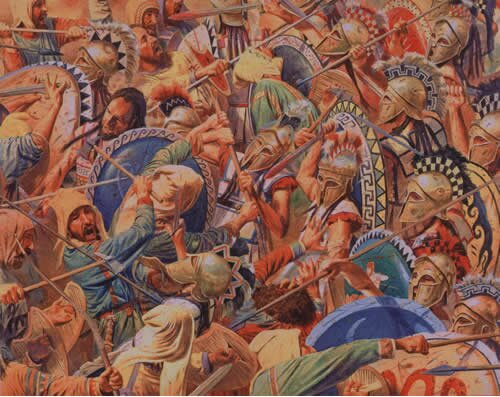
The Greek allied phalanx hit the advancing lines with devestating consequences, the soliders so tightly packed together that their shields overlapped leaving minimal gaps, long spears protuding out not only from those in the front but from those in the second, third, fourth, fifth and even sixth rows. Those in the seventh and eighth rows, ready to fill in any gaps that might occur had the added responcibility of pushing the front ranks in their back thus any clash resulted in the Persians being pushed back, this caused consternation for the barbarians on the battle field, not being able to establish any front against the Greeks.
 |
So many long deadly spears thrusting outwards towards Persian necks slamming into them. Decades of Spartan military training has already taught them the weak spots of a soliders equipment and compared to Greek armour, the Persians were vastly inferior. Advancing against the phalanx a Persian might have a shield and helmet made of reeds, wood and cloth and he faced shields made of bronze and hard wood, the Greek's wore Corinthian helmets beaten into shape by a single sheet of bronze, leaving no seams. The Persians weapon of choice might include a spear and a short sword, advancing either at a run or in no particular order or cohesion.
Wave after wave they probed and pushed forward, only to face a thicket of death, the body count became uncountable, the ground giving way as the dead covered the battlefield. Onward they pushed foward, many more times they outnumbered the Greeks, but no matter how they tried the Greek phalanx refused to faulter, the ground becoming slippery, with blood, bile and waste the killing fields at the pass of Thermopylae, was fast becoming the massacre of the Medes.
In this way it became clear to all, and especially to the king, that though he had plenty of combatants, he had but very few warriors. The struggle, however, continued during the whole day.
Then silence, the barbarians withdrew, the king called forward his 'Immortals' (in reality they were called 'Companions') lead by Hydarnes. Out of his entire army they had the closest to superior armour and weapons. They moved forward and the Lacedaemonians waiting patiently for them.
The two armies fought in a narrow space, the Persian's numbers nullified by the confinement. The Spartans ripped through their lines but for every one they killed another would rise to take his spot (thus 'Immortals').
Spartan military tactics were employed during the fighting. The call would come and the Spartans would retreat! At which the barbarians would rush after them with much noise and shouting, when suddenly the Spartans would wheel around and face their pursuers, in this way they destroyed even more vast numbers. Some Spartans likewise fell, but only a few.
Xerxes, who was watching from his throne, would leap out of his seat in terror as he witnessed the onslaught.
After a day of battle, at last the call came for the Persians to withdraw, finding that all their efforts to gain the pass came to nothing. Whether they attacked by division or in any other way, it was to no purpose, they withdrew to their camp.
The next day the Persian took to the pass again with renewed vigor. Xerxes knew the Greeks were so few and hopefully disabled, tired, weary by reason of their wounds, so they once more attacked.
The Greek lined up in detachments according to their cities, and bore the brunt of the battle in turns.
From the back, whips cracked and the barbarians howled at their men to 'Go forward' and like cattle they did. Faced with the spears of an armoured hedgehog those at the front cryed 'Go back'. The Persians found no better success, they could not get through the pass, the more they pushed, the more the Greeks stood firm, many Persians falling to their death over the ridge onto the rocks below, pushed by their own men behind and facing a phalanx of spears ahead. The massacre continued all day.
The nations from Asia and Africa decending into Greece and now at the front gate, not one man could get through. The king was in a great strait, and knew not how he should deal with the emergency.
Xerxes was desperate but his luck changed when a Malian named Ephialtes told him about a secret path across the mountain. Immediately a strong Persian force was sent with Hyrdanes, guided by the traitor. At day's break they reached the summit, where the Phocian army was stationed and who upon seeing the Persians fled to a crest of a mountain and got ready for a battle. The Persians understanding the situation, left the Phocians at the crest and ascended the mountain, to gain access behind the Greek line.
The Greeks had received warning from a seer called Megistias, who read their fate in the victims he was sacrificing. Some deserters came in and brought the news that the Persians were marching round the hill; it was still night when these men arrived. Scouts came running down the hill bringing the same account.
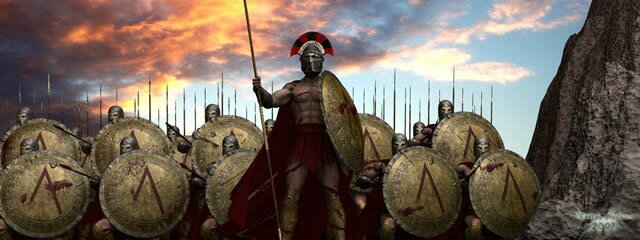 Artwork by Kostas Nikellis <>
|
When Leonidas learned all these incidents, he ordered the council of war to be summoned. Many were of the opinion that they should retire or find a better defendable place. Part of the troops departed and went their ways homeward to their several states. Nobody questioned if the Spartans would leave their post, this was not a question that they needed an answer to.
There is strong evidence to suggest Leonidas sent away the troops. The Oracle had previously declared that a Spartan King must die or the Persians would conquer Sparta {O11}. The 300 Spartan guards he took with him were specially hand picked as being fathers to sons in Sparta, the family line of every Spartan there would live on, there was no reason that others had to die as well. Thermopylae was the place where Hercules had died, thowing himself into the water as he burnt with fire, the site became know as "the hot gates", due to the thermal springs: The Spartans believed they were a direct descendant of Hercules. They would die here as the Oracle, Sparta and the Hercule's blood line demanded. Megistias did receive orders to flee, he refused, but did allow his son to depart. Thus this story is true as the son relates.
So the orders were given and the allies departed. Only the Thespians and the Thebans[3] remained with the Spartans; refusing to retreat, and declaring that they would not forsake Leonidas and his followers. Leonidas looked at what remained of his force with the dout affection of all last-ditch commanders; 'Have a good breakfast men, for we dine in Hades!' Two of the Spartans were suffering from inflammation of the eyes (probably from the dust kicked up in the air), one of them, hearing of the last-ditch stand, told his Helot servant to lead him to the front rank where, nearly blind as he was, he would still be able to strike out and take at least one or more of the enemy with him. The helot did this then turned and fled.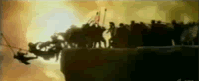
Before the body of Persians, who were crossing the mountain under Hydarnes could attack him in the rear and hopeless now of preserving their lives, and anxious only to sell them dearly, Leonidas did not wait the Persian attack, which had been delayed by Xerxes and advanced in the path, and here he fell upon the Persians. Advancing to the more open portion of the pass, here he had held the station at the wall, and from this had gone forth to battle beyond the defile, and carried slaughter amongst the barbarians, who fell in heaps.
Behind the captains of the squadrons, armed with whips, urged their men forward with continual blows. Many were thrust into the sea, and there perished; a still greater number were trampled to death by their own soldiers; no one heeded the dying. For the Greeks, reckless of their own safety and desperate, as the mountain had been crossed, their destruction was immenent, exerted themselves with most furious valour against the barbarians.
Thousands slain, two the Persian's kings brothers fought and fell, numbers driven into the sea, but when the Spartan spears broke, they started having losses and one of the first that fell was King Leonidas.
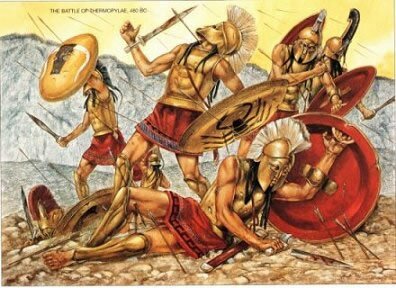 Around his body one of the fiercest battles took place. Four times the Persians attacked to obtain it and four times were denied [4]. At the end, the Spartans exhausted and wounded, carrying the body of Leonidas, retired behind the wall, and posted themselves on a hill lock. With the demise of the Spartan king and most of the Thespians and Thebans now dead, the last of their remnants surrendered.
The Spartan hoplite force fought on and defended themselves to the last, such that still had swords the others throwing rocks and using their hands and teeth.
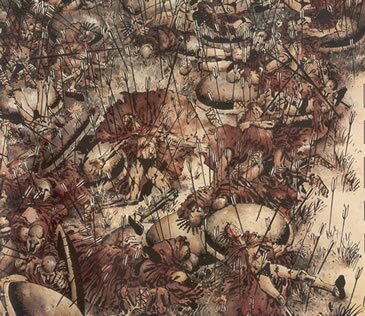
At last they were encircled upon every side, with Xerxes army jeering to cut them to ribbons, Xerxes did a unfortunate thing and ordered that they all be showered with 'thrown things' (arrows, javlins, rocks etc). This could not have put faith in his followers who might have thought that the king didn't want to risk any more of his men in close combat.

As the army filed past the head of Leonidas, that was nailed to a cross, they must of thought that their task was nearly at hand, just a few days march and the city of Athens would be theirs, and still somewhere up ahead; Sparta.
Note: Herodotus claims Xerxes had brought 5 million to the battle but this can hardly be true. Believed to be a mistake, Greeks who were use to battles of at most ten thousand had never seen so many people before (Xerxes had brought Asia with him), the claim of 5 million would be like someone today saying 'there was millions of them', a number that is given when you don't really know. Diodorus says that the Persian land army alone was a million men [1].
This web site goes with the idea that Herodotus calculation for the word 'myriad' is the key. In Ancient Greece that word would have meant 10,000 while in the east it meant a fighting force of 1,000. So, while he states 5 million, we believe it closer to 500,000. If his sources were therefore Persian, the mistake would have been made. Any retreived archive records or interigation of prisoners revealing 500 myriad would have caused the confusion.
NEXT PAGE>>>Battle of Thermopylae, topics of discussion
References:
'Histories' by Herodotus published by Wordsworth 1996
'The Greco-Persian Wars' by Peter Green published by University of California Press 1998
- ^ Diodorus Siculus 'The Historical Library of Didorus Siculus' Book 11 Chapter 1 page 363
Other Notes:
Logo banner and artwork by Kostas Nikellis <>
Art references
Jacques-Louis David - Leonidas at Thermopylae 1814 A.D. at the Louvre Museum
Book references
- Histories written by Herodotus (written around 450 BCE), published by Wordsworth Classics 1996 (see Book 7 Section 201)
-Thermopylae - The Battle for the West written by Ernle Bradford, published by Da Capo Press 1980 (the whole book is dedicated to the battle)
- A History of the Greek City States 700-338 B.C. written by Raphael Sealey, published by University of California Press 1976 (See Chapter 8 - Persia and Greece II: The Hellenic League)