Battle of Himera - 480 B.C.
Western and north-western Sicily were largely controlled by Carthaginian colonies while the Greeks were mainly on the eastern and south-eastern coasts. Hamilcar, the leading Carthaginian general, had laid his plans accordingly and a vast flotilla of transports with horses made their way to Sicily[1]. While the oared warships could advance well enough across the Mediterranean the sailed transports inevitabley lagged behind, dependant largely upon a favourable southerly wind to waft them on their course towards the coast of Sicily. Unfortunately for the Carthaginian hopes were dashed when a 'master-wind' elected to blow hard from the north, and out of the wallowing transports many of them sunk. Leaving Hamilcar in a worse position than Xerxes as at least his baggage train was on dry land.
The warships pushed on, the first objective was the city of Himera, as a former ruler Terillus had gone to Hamilcar for aid and nothing suited the Punic-Persian alliance better. Indeed, the invasion would have happend anyway, but now they had a legitimate reason. Carthage wanted to elliminate a powerful Greek threat, and then in due course to move east and one by one take over the Greek cities, this was always their long term strategy. Beyond that, a move up into southern Italy where prosperous colonies beckoned. It is significant that both Corsicans and Sardinians, who had long cast envious eyes on the richness of mainlan Italy and their technology, were amoung the vast army who accompanied Hamilcar on his expedition.
Having disembarked and beached their ships in the grand Bay of Panormus, the invasion force rested for three days. The loss of so many transports, of food, provisions, general stores and horses, had left the great army somewhat depleted but, as Hamilcar was swift to asure them-the sea had been their greatest danger.
Unlike the invasion of Xerxes, where the route or the army could be fairly easily forseen, the invasion of Sicily could have started at several points, the most likely perhaps being the city of Selinus in the south which was allied to Carthage. Gelon, therefore, whose main fleet-base was Syracuse had no means of knowing where the blow would fall.
Even now when it became known where Hamilcar's army had landed in Panormus Bay the Greek fleet could not head north and make it's way through the Messina Strait. Pro-Carthaginian cities were in the way. Rhegium was ruled by the son-in-law of Terillus the deposed ruler of Himera, while his own son ((the grandson of Terillus)) was ruler of Zancle.
As can now by seen the Carthagians had good reason to believe that with these combination of alliances they could box in the Greeks and eliminating them at their leisure.
Himera had just enough time to gather reimforcements from over land before the Carthaginas were ready to attack.
The Carthaginans leaving twenty triremes to partol the coast, fortified his camp and extended its defences inland so that they reached the hills to the west of the city, thus leaving Himera cut off except for its southern and eastern approaches.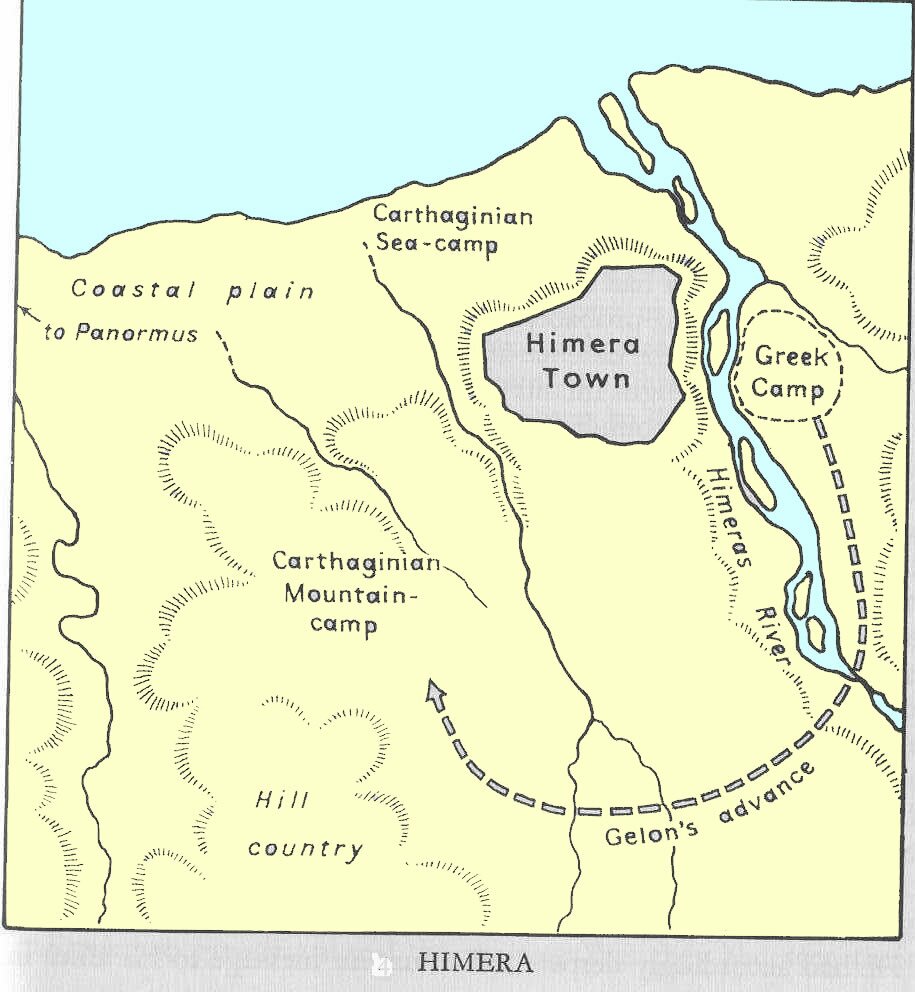
Hamilcar made the first move and sent a powerful detachment of troops to test the walls and defences of the city, in the course of which the defenders were rash enough to sally out, only to be beaten back with the loss of many men. Realising now that they best chances were with their walls holding out, so they had the city walls on the west side blocked up and sent a message calling for help from Gelon of Syracuse.
Gelon had already mobilsed his forces at his command, which most probably included the 20,000 hoplites that he had promised for the defence of Greece, as well as several thousand archers, slingers, light infantry, and 2,000 cavalrymen. Taking a swift overland route and being reimforced by Heron of Gelan , the troops that finally reached Himera from the south-east amounted to 50,000 men. The joy of the besieged was reinforced by the immediate proof of the ablilites of this considerable army. The now 5,000 strong cavalry bypassed the wester flank of Hamilcar's dences and captured or cut down hundreds of his troops who were out foraging in the countryside.
Hamilcar still held the numerical advantage over his Greek opponents but he was sadly hampered by the fact that he had lost so many horses in the wrecked and sucken transports - thus reducing many of his formidable cavalrymen to the unfamiliar role of foot-soldiers. Accordingly he dispatched an urgent message to his allies in Selinus asking them to send all their available cavalry. Unfortunatley for the Carthaginian Suffete the returning messenger from Selinus was intercepted by the Greeks, who were roaming the countryside almost unchallenged! This was an almost miraculous stroke of fortune, for the message even revealed on what day cavalry from Slinus were due to appear-obviously so the lookouts would let them into the camp and not mistake them for the enemy.
Gelan's first plan was to make a raid on the enemies ships for while the Carthaginians couldn't get any provision from the land, their supply ships could come and go as they pleased, supplying them with all their wants. Now Gelan came across a brilliant idea. As Selinus, although an ally of Carthage, was a Greek city, and its soldiers and cavalrymen bore the same uniforms, armour, and horse-trappings as any of the other Sicilian Greeks. On the appointed day, when the Carthaginians would be expecting the cavalry from Selinus, he would anticipate them, sending out his finest squadron from Syracuse to make a detour into the hills while it was dark and then show themselves as the expected reimforcements. As soon as they were admitted through the palisade they would declare their true nature, wreak as much destruction as possible, and above all, if they could find him, kill Hamilcar. Gelon had scouts posted on the hills overlooking the town to give the signal the moment that they had seen their cavalry admitted. Gelan with all his remaining troops would unleash an assault on the Carthaginian position while the balance of the troops in Himera would also burst out in a head long attack.
Hamilcar had intended on that day to make a great scrifice to the Greek sea-god Poseidon, and early that morning came out wearing his sacrifical robes. Beasts of all types were slaughtered to the newly built alter, when the cavalry men arrived.
No sooner were they through the gate than they set about firing tents, ships, and anything else that would burn to add to general confusion. Within mintues troops from the east struck and more troops poured out of Himera. Hamilcar dressed in priestly robes and officiating over the great offering to Poseidon was a figure that could hardly escape notice, he was cut down in front of the blazing sacrifical altar and his body hurled onto it to join the previous victims.
|

Artwork: The surprise of Himera
|
Dispite the unexpected nature of the attack, the Carthaginians still had the greater man-power, and hand to hand combat now took place. Some of the Greeks started looting thinking victory was theirs. A Spanish lead counter attack now threatened the Greek position. News of Himilcar's death now was hollered out in the camp and must have served to complete the demoralisation of his army and, in their ensuing flight, hundreds of them were slaughtered. Gelon had given orders for no quarter to be given. A large number of survivors, however, managed to escape to a hill position ((probably Mount Calogero, about five miles west of Himera)). Gelon had the hill surrounded, but made no move to attempt any assault on the Carthaginian position. He knew something that the foreigners did not. Calogero is waterless, as soon as they were thirsty enough they all surrendered.
Their lives were spared, something like half of Hamilcar's army now became Greek slaves, they would work for the rest of their lives enriching with their labour the cities of their Sicilian masters.
For the fleet we assume all the beached ones were captured or destroyed. The 20 on coast guard picked up as many of their men as they dared and headed home. More termulturous weather, more sucken wreckages littered the Meditteranian, only one would make it safely back home.
The invasion was such a disaster that Carthage, terrified that the triumphant Greeks might swoop down and sack their great city by the sea, sent ambassadors to Gelon to organise a peace treaty. Gelon could afford to dictate his own terms, including a large sum of money.
The battle of Himera, which for many years to come eliminated the Eastern and African threat to Sicily and the West, was rightly recognised at the time for what it was - a brilliant victory that rivalled that of Salamis. Many belived that the battle took place on the same day as Salamis, but it is far more likely that Gelon was triumphant in Sicily on or about the day that Leonidas and the three hundred were dying in the rocky pass in distant Greece.
Hannibal Mago the grandson of Hamilcar would exact revenge on Siciliy at a later date.
References:
- Current archaeology at the site. Visit the Archaeological Institue of America


